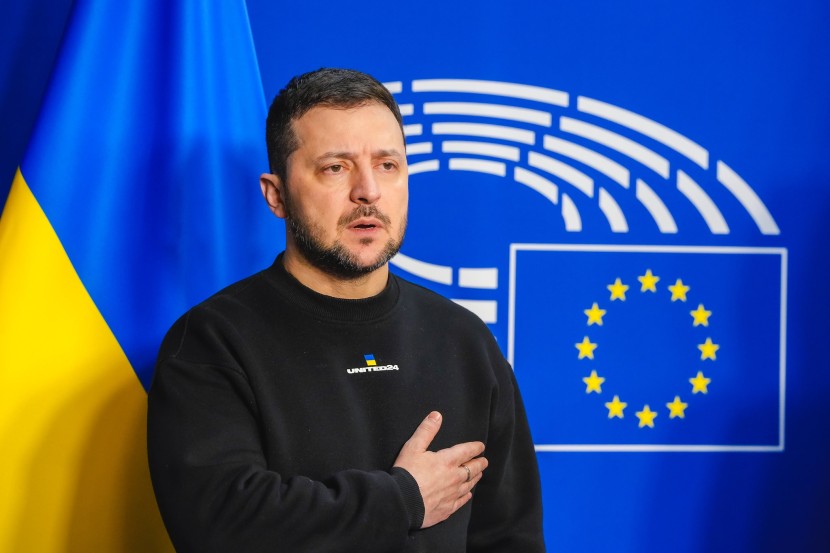
Ukraine aims for EU accession by 2027, signalling a shift away from NATO aspirations, as political and regional tensions threaten to complicate its integration process.
Zelenskyy's bold EU accession timeline
Ukrainian President Volodymyr Zelenskyy has recently doubled down on a target for Ukraine to join the European Union by 2027.
'Technically, we will be ready in 2027,' he said, asserting that by then, the key reforms and implementation steps will be completed by the end of 2026.
Zelenskyy views EU membership as a vital security and economic anchor, especially amid the ongoing war with Russia. His government argues that accession would provide Ukraine with stronger political stability and access to EU funds necessary for reconstruction.
'Ukraine's accession to the European Union is one of the key security guarantees not only for us, but also for all of Europe,' he told reporters.
'That is why we are speaking about a concrete date, 2027, and we count on partners' support for our position,' Zelenskyy said.
During a conversation with Federal Chancellor of Austria @_CStocker, we discussed the energy situation in Ukraine. Russia strikes energy infrastructure every day to leave Ukrainians without electricity and heat, and it is very important that partners respond to this. That is why… pic.twitter.com/TIsmncBYMe
— Volodymyr Zelenskyy / Володимир Зеленський (@ZelenskyyUa) January 27, 2026
European officials, however, express caution.
Luxembourg's Foreign Minister Xavier Bettel called for adherence to established rules, warning against setting unrealistic timelines.
'We have rules and we need to respect them,' Bettel said.
EU enlargement commissioner Marta Kos acknowledged the political will but suggested that technical readiness remains uncertain, citing reports indicating limited progress in critical areas such as anti-corruption measures and institutional reforms.
The European Commission's recent assessments have highlighted Ukraine's ongoing challenges. While progress has been noted, issues like judicial reforms, transparency, and anti-corruption efforts remain unresolved.
'There is a discussion (of whether) we should see EU enlargement slightly differently: What we have now is, if all the work is done, and there is a yes or no decision at the end of the process,' an EU official, who remains unnamed, has told Euronews.
Likewise, German Chancellor Friedrich Merz said Ukraine in the EU next year is not a feasible.
'Accession on January 1, 2027, is out of the question. It's not possible,' he told DPA News Agency. However, the chancellor also mentioned other ways to have it happen.
'We can slowly bring Ukraine closer to the European Union along the way,' he said.
EU leaders emphasise that accession depends on meeting strict criteria, which could take years, regardless of Kyiv's ambitions.
Ukraine's NATO and EU aspirations
Since gaining independence in 1991, Ukraine's relationship with Western alliances has evolved gradually. During the 1990s and early 2000s, Ukraine maintained a stance of neutrality while cooperating with NATO through partnerships and joint exercises.
The country's desire to join NATO grew stronger after Russia's annexation of Crimea in 2014 and subsequent conflicts in eastern Ukraine.
Despite this, Ukraine's official policy remained cautious, emphasising cooperation rather than immediate membership.
In recent years, the focus shifted decisively towards NATO membership.
The 2022 invasion by Russia intensified Ukraine's security concerns, prompting open calls from Kyiv for swift integration into NATO.
However, political realities within the alliance, notably some member states' reluctance to extend full membership to Ukraine during ongoing conflicts, have complicated efforts.
Many analysts see Ukraine's NATO prospects as uncertain in the near term, prompting Kyiv to explore alternative security guarantees and integration pathways.
Regional opposition from Hungary, Berlin, others
While Zelenskyy projects confidence, opposition within the EU complicates Ukraine's bid.
Hungary's Prime Minister Viktor Orbán is among the most vocal critics.
‼️President Zelensky has stated that Ukraine aims to join the European Union as early as 2027. 👉 The Brussels elite is already working to implement this plan. This poses an immediate and direct threat to 🇪🇺Europeans and 🇭🇺 Hungarians alike — which is why the patriotic government… pic.twitter.com/MYdti2jXVN
— Balázs Orbán (@BalazsOrban_HU) January 27, 2026
'95% of Hungarians have rejected Ukraine's fast-tracked EU membership because they want to protect our farmers, the safety of our families, and peace in Hungary,' Orbán told reporters.
Orbán claims that the EU leaders received documents indicating an intention to admit Ukraine by 2027, primarily motivated by access to the next multi-year EU budget. He argues that this move would divert funds from Central Europe and threaten regional stability.
Orbán's opposition is rooted in concerns over Ukraine's ability to protect Europe from Russia, asserting that Ukraine's inclusion would not strengthen European security but rather drag the continent into further conflict.
His stance aligns with a broader narrative that Ukraine should remain in a buffer zone or between NATO and the EU, rather than fully joining either bloc.
The opposition is also influenced by domestic politics. Hungary faces an upcoming parliamentary election, with Orbán's Fidesz government trailing opposition parties in recent polls.
The Ukraine issue has become a key campaign topic, with critics accusing Orbán of using the narrative to rally nationalist sentiments and oppose Brussels' policies.
The debate over Ukraine's accession reflects broader tensions within the EU about enlargement strategy, regional security, and resource allocation.
EU officials have acknowledged Ukraine's progress but emphasise that accession requires consensus among all 27 member states.
Originally published on IBTimes UK
© Copyright IBTimes 2025. All rights reserved.


