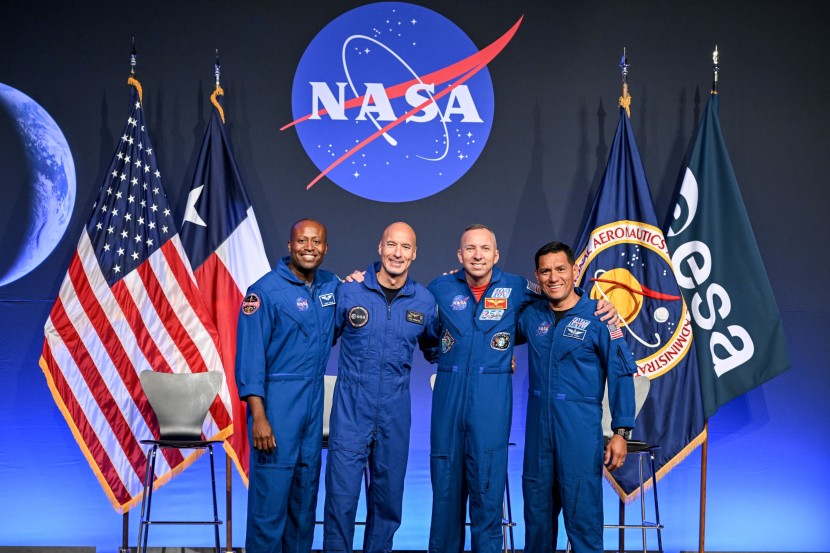
NASA has named the four astronauts who will fly its Artemis III mission, a 2027 test flight in Earth orbit meant to pave the way for a return of humans to the Moon's surface, the agency announced this week. The reveal came as NASA prepares to bring a space exhibit to the FIFA World Cup, which opens Thursday.
The crew, introduced Tuesday at NASA's Johnson Space Center in Houston, is commander Randy Bresnik, a NASA astronaut and retired U.S. Marine; pilot Luca Parmitano, an Italian astronaut with the European Space Agency; and mission specialists Frank Rubio and Andre Douglas, both of NASA. Veteran astronaut Bob Hines was named as a backup who will train alongside the crew.
Unlike a lunar landing, the roughly two-week Artemis III flight will remain in low Earth orbit, where the crew will test docking procedures with commercial lunar landers being developed by SpaceX and Blue Origin, according to NASA and CNN. The agency described the flight as a step toward Artemis IV, which it has slated as a crewed mission to the Moon's south pole in 2028. The crew will launch aboard the agency's Space Launch System rocket and Orion spacecraft from Kennedy Space Center in Florida.
The four bring extensive flight and engineering backgrounds. Rubio, a physician and former Army Black Hawk pilot, holds the U.S. record for the longest single spaceflight at 371 days. Bresnik has flown to space twice, including a stint commanding the International Space Station. Parmitano, an Italian Air Force colonel, was the first Italian to command the ISS, and will be the only non-U.S. citizen on the flight. Douglas, a former Coast Guard officer and engineer, will be making his first trip to space. No women were named to the prime crew.
"Today we take another bold step in humanity's return to the moon," NASA Administrator Jared Isaacman said, crediting the earlier Artemis II crew, which flew around the Moon in April, with reigniting interest in exploration. The new crew has about a year to train under the current timeline.
The announcement dovetails with NASA's plans around the World Cup. From June 11 to July 19, the agency will host a free exhibit at the FIFA Fan Festival in Houston, where visitors can learn about International Space Station research and the Artemis program, NASA said. The agency noted that ISS experiments have studied how a soccer ball's internal mass affects its flight, and wind tunnel tests at its Ames Research Center have examined how panel shape and seams influence a ball's movement.
© 2026 HNGN, All rights reserved. Do not reproduce without permission.