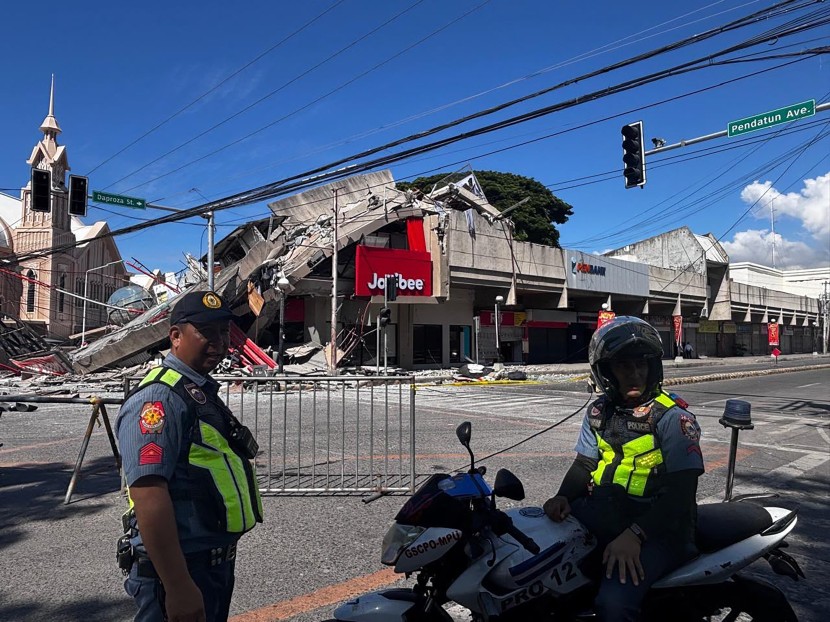
A powerful magnitude 7.8 earthquake struck off the southern Philippines on Monday, killing at least 32 people and injuring more than 200, toppling buildings across Mindanao and sending a tsunami into nearby coasts.
The quake hit at 7:37 a.m. local time, with an epicenter offshore near Sarangani province at the southern tip of Mindanao island. It was centered at sea at a depth of about 33 kilometers (20 miles), roughly 32 kilometers southwest of the town of Maasim, according to the Philippine Institute of Volcanology and Seismology (Phivolcs). Phivolcs initially recorded the quake at magnitude 7.0 before upgrading it to 7.8. By some measures it was among the strongest tremors to hit the country in decades.
The death count rose steadily through the day as reports filtered in from remote areas. The toll climbed to at least 32, including 13 villagers killed in a landslide in Glan, Sarangani province, and four others elsewhere in Sarangani. Earlier, the National Disaster Risk Reduction and Management Council (NDRRMC) had confirmed 19 deaths — 16 in the Soccsksargen region and three in the Davao region — along with 134 injured and 12 missing, cautioning that figures were still being validated. Authorities said nearly two dozen people were missing and about 10,000 residents had been preemptively evacuated.
General Santos, a southern port city of more than 700,000 people and a hub for the tuna export industry, was among the worst affected. There, at least seven people were killed and roughly 130 injured, with several small buildings partially collapsed and a key access bridge left with dangerous cracks, regional civil defense director Rod Sosmeña said. A donation center and a building housing a Jollibee restaurant and a Love Radio studio collapsed in the city, and a high school in Matanao came down. Parts of the city's St. Elizabeth Hospital were severely damaged, forcing patients and staff to evacuate and operate outside the main building, a police spokesperson said. The Department of Public Works and Highways estimated initial damage in General Santos alone at roughly 1 billion pesos.
The quake struck on what was meant to be the first day of school, affecting 3.2 million students and 128,000 teachers and personnel. Footage from Davao showed schoolchildren ducking for cover during morning flag-raising ceremonies. President Ferdinand Marcos Jr. said he had ordered the closure of schools in affected areas and activated emergency agencies, including the Office of Civil Defense and the NDRRMC.
Tsunami warnings were issued in the Philippines, Indonesia, Palau, Taiwan and Papua New Guinea after the offshore quake, with waves of about 1 meter (3 feet) reaching nearby coasts and smaller waves measured in Indonesia, Palau and as far away as southern Japan. About five hours later, the Pacific Tsunami Warning Center said the threat had largely passed, and Phivolcs reported no casualties from the tsunami itself.
Rescue teams searched through the rubble of collapsed structures into the afternoon. The Bureau of Fire Protection conducted search-and-rescue operations at a damaged commercial building and a warehouse, while authorities verified reports that students may have been trapped in a collapsed structure. Marcos pledged that the national government would "not leave Mindanao behind."
The Philippines sits on the Pacific "Ring of Fire," an arc of intense seismic activity where earthquakes are a near-daily occurrence, though destructive ones strike unpredictably.
© 2026 HNGN, All rights reserved. Do not reproduce without permission.


