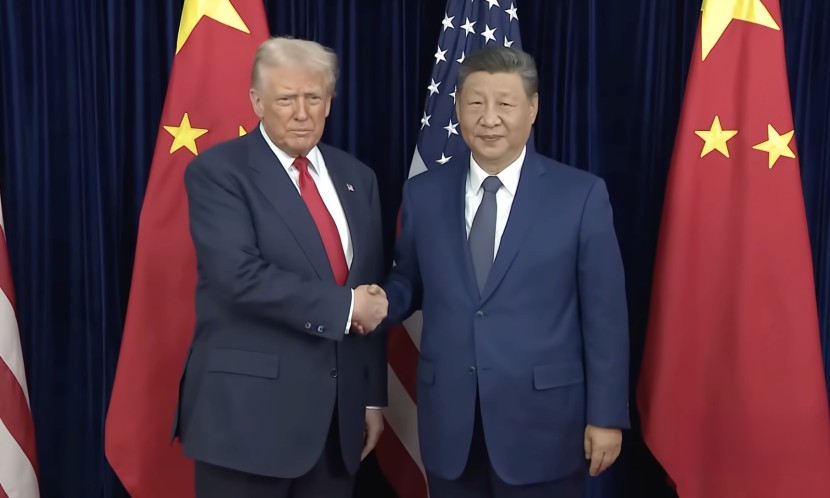
Donald Trump claimed on Tuesday that Chinese President Xi Jinping is 'very happy' with his efforts to reopen the Strait of Hormuz and predicted Xi would give him a 'big, fat, hug' when the two leaders meet in China in the coming weeks, linking his Iran strategy directly to Beijing's interests.
The comments came after weeks of escalating tension around the Strait of Hormuz, the narrow waterway off Iran that handles a major share of global oil shipments. Trump has pushed Iran to fully reopen the route and has ordered US forces to begin a blockade of their own, presenting it as a move that will soon restore traffic through one of China's most important energy lifelines. Throughout the conflict with Iran, the US president has repeatedly declared victory, even as reports from the region have described a far more tangled reality on the ground.
The latest remarks appeared in a characteristically exuberant post on Trump's preferred social media platform, Truth Social, where he framed the reopening of the Strait as a gift to Beijing and the wider world. 'China is very happy that I am permanently opening the Strait of Hormuz. I am doing it for them, also – And the World. This situation will never happen again. They have agreed not to send weapons to Iran,' he wrote.
— Rapid Response 47 (@RapidResponse47) April 15, 2026
He then turned to personal chemistry with Xi, adding: 'President Xi will give me a big, fat, hug when I get there in a few weeks. We are working together smartly, and very well! Doesn't that beat fighting??? BUT REMEMBER, we are very good at fighting, if we have to – far better than anyone else!!!'
Trump's Iran Claims And The Strait Of Hormuz
Trump's language on Iran and the Strait of Hormuz has followed a familiar pattern: grandiose assurance first, detail later, if at all. He has told supporters that the war with Iran is 'close to over,' a line he repeated in clips released from an interview with the Fox Business Network, even as no clear settlement has been announced and no formal end to hostilities declared.
The Strait of Hormuz is not just a strategic talking point. It is a chokepoint for global oil flows and a particular priority for China, which relies heavily on energy imports shipped through those waters. Trump's claim that he is 'permanently opening' the route and that such a crisis 'will never happen again' is, at this stage, his assertion rather than a verifiable fact. No formal US–China agreement on Hormuz, or on weapons supplies to Iran, has been publicly released.
Equally striking is his assertion that China has 'agreed not to send weapons to Iran.' If accurate, it would mark a significant diplomatic concession from Beijing. Yet so far, there has been no corroborating statement from Chinese officials, no accompanying treaty text, and no confirmation from independent sources. Until such documentation appears, that particular line has to be treated cautiously, as one more unverified pledge in a crowded field of Trump-era promises.
US military officials have acknowledged increased operations around the waterway and a blockade initiated this week, tying it to pressure on Tehran to ensure shipping lanes are open. What they have not done is echo Trump's more colourful language about permanent solutions or imminent hugs.
Xi Jinping, Iran, And Trump's 'Big, Fat, Hug' Prediction
Trump's prediction of a 'big, fat, hug' from Xi lands awkwardly against the backdrop of Beijing's publicly stated priorities. While Trump casts the Chinese leader as an almost enthusiastic partner in his Iran policy, Xi has been emphasising something else entirely: the durability of China's relationship with Russia and its role in what Beijing calls the 'Global South.'
In Beijing, during a meeting with Russian foreign minister Sergei Lavrov, Xi described the 'stability and certainty' of China–Russia ties as 'particularly precious' amid an unstable international environment, according to state broadcaster CCTV. He hailed the 'strong vitality and exemplary significance' of their friendship treaty and called for 'closer and stronger strategic collaboration' to defend both countries' 'legitimate interests' and to safeguard the unity of Global South nations.
It is a very different tone from Trump's social media flourish about reopening a vital oil route to benefit China. When Russian President Vladimir Putin visited China in September, Xi greeted him as an 'old friend,' underscoring the depth of that partnership at a time when Moscow is increasingly isolated in the West. Now, with Lavrov in Beijing, Xi is again presenting Russia as a central pillar of China's foreign policy, not a side note in someone else's Middle East strategy.
None of that means Xi is unhappy that oil flows through Hormuz may resume more smoothly, if Trump delivers on his promise. China's economy is energy-hungry and pragmatic, and any reduction in shipping risk in the Gulf would be quietly welcomed in Beijing and beyond. But between Trump's swagger about a coming embrace and Xi's carefully scripted remarks about Russia and the Global South, there is a gap that only hard evidence can bridge.
So far, there is no Chinese readout endorsing Trump's version of events, no public confirmation of a weapons pledge on Iran, and no official word on what exactly will be on the agenda when the two men next meet. Until those pieces surface, the 'big, fat, hug' remains what it sounds like: a piece of political theatre from a president who prefers to write his own script, even when other actors have not yet agreed to the lines.
Originally published on IBTimes UK
© Copyright IBTimes 2025. All rights reserved.


