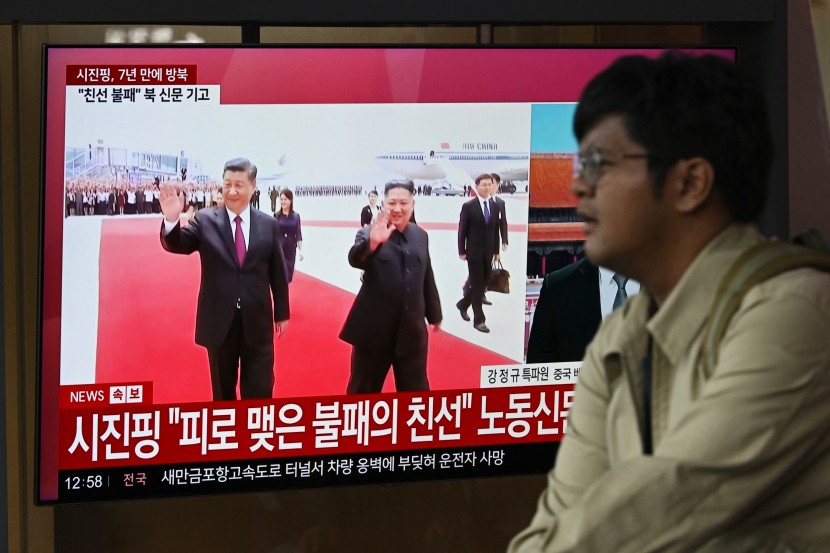
Chinese President Xi Jinping arrived in Pyongyang on Monday for a rare two-day state visit, his first trip to North Korea in nearly seven years, and called for deepening "strategic coordination and cooperation" with leader Kim Jong Un.
Kim and his wife, Ri Sol Ju, greeted Xi and his wife, Peng Liyuan, at the airport, where the Chinese leader was given a lavish welcome that included children presenting bouquets and cheering crowds in the capital. Streets in Pyongyang were lined with the national flags of both countries ahead of the visit.
The two sides should inject "powerful momentum" into their relationship, Xi said during his meeting with Kim, according to a readout from Chinese state media. China was ready to expand cooperation in areas including trade, agriculture, health, construction, and science and technology, he added. Xi told Kim that no matter how the international situation changes, China's high regard for the traditional friendship between the two countries would not change. Kim, in turn, said the visit demonstrated how unbreakable the ties between the two nations are, according to North Korean state media.
The trip is widely seen as an attempt by Beijing to reassert its role as North Korea's most important economic lifeline and diplomatic partner. It comes as Kim has drawn closer to Russia in recent years, sending troops and conventional weapons to support Moscow's war against Ukraine. North Korea has long sought to balance between Russia and China, securing military and economic benefits from both while avoiding overreliance on either.
Xi's decision to travel at all was notable. The Chinese leader has steadily reduced his foreign trips in recent years, with figures such as U.S. President Donald Trump and Russian President Vladimir Putin generally traveling to Beijing instead. Xi last hosted Kim in the Chinese capital in September 2025, during a military parade marking 80 years since the end of World War II, where the three leaders projected a show of unity. The current visit also coincides with the 65th anniversary of the 1961 China-North Korea mutual defense treaty, Beijing's only formal military alliance.
The summit unfolded against the backdrop of North Korea's expanding weapons programs. A day before Xi's arrival, North Korean state media reported that Kim had inspected a major munitions company and was briefed on expanding production of ballistic and cruise missiles. The previous week, Kim visited a new plant manufacturing weapons-grade nuclear material and said the country would build up its nuclear forces at an exponential rate. It remained unclear how much the North's nuclear program would feature in the talks.
Some analysts said Xi was likely to offer economic incentives such as shipments of rice and fertilizer, a resumption of Chinese group tourism and joint economic projects, while avoiding pressure on denuclearization — an approach that, if borne out, would matter to Kim, who has sought international recognition as a nuclear-armed state and the lifting of U.N. sanctions. In the readout from the September 2025 summit, the phrase "denuclearization of the Korean Peninsula" was absent for the first time, breaking with the language of the leaders' earlier meetings.
In Seoul, the visit was being closely watched, with images of the two leaders broadcast on news screens across the South Korean capital. Xi's visit is scheduled to continue through Tuesday.
© 2026 HNGN, All rights reserved. Do not reproduce without permission.


