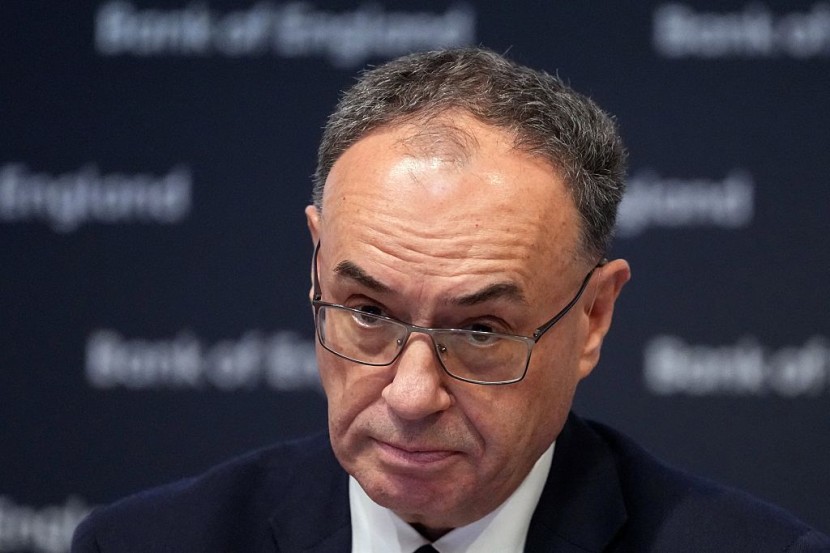
Bank of England Governor Andrew Bailey said Friday that the central bank can temporarily tolerate inflation running above its 2% target to support the U.K.'s weak economy, as long as longer-term price pressures do not take hold.
Bailey made the remarks in a speech delivered at an economic conference in Reykjavík, Iceland, organized by Iceland's central bank.
He said that "given the context of softness in the real economy and uncertainty around the scale and duration of the shock, tolerating above-target inflation temporarily to provide some support for the real economy is an appropriate way to approach the trade-off," according to the Wall Street Journal.
He added that the tolerance for above-target inflation "would weaken if signs of second-round effects begin to emerge," referring to longer-term wage and pricing pressures.
Bailey also noted that the Bank of England had already effectively tightened its monetary policy by removing expectations of rate cuts that markets had priced in before the U.S. and Israel launched military strikes against Iran in late February.
"Having taken expected cuts off the table for now, we have already tightened policy considerably in response to the shock relative to what had been expected by markets," Bailey said, adding that "this is already affecting the economy." He said interest rates on new mortgage loans had risen as a result of that shift.
The Bank's Monetary Policy Committee voted 8-1 to hold the Bank Rate steady at 3.75% at its Apr. 30 meeting, with MPC member Huw Pill casting the lone dissenting vote in favor of raising rates to 4%, Trading Economics reported.
U.K. consumer price index inflation stood at 3.3% in March 2026 before easing slightly to 2.8% in April, still well above the BOE's 2% target. MPC projections suggest inflation could climb toward 3.5% or higher later in 2026 as energy costs pass through to utility bills and supply chains.
Bailey acknowledged that monetary policy cannot directly shield the economy from higher global energy prices, saying "there is nothing monetary policy can do to prevent higher energy prices from affecting businesses and households."
He warned that for net importers of energy like the U.K., "the terms of trade have worsened and real incomes will fall." The ongoing Middle East conflict has been identified by the BOE as the primary driver of energy price disruption and the resulting inflation surge.
The governor also cautioned that reacting too aggressively to inflation concerns at this stage "may generate undesirable volatility" in the economy. KPMG forecasts U.K. GDP growth will slow to just 0.8% in 2026, down from 1.4% in 2025, with inflation expected to peak at around 3.6% in September 2026.
Financial markets are fully pricing in one quarter-point BOE rate hike and see roughly a one-in-three chance of a second hike over the remainder of 2026. The BOE's next rate decision is scheduled for Jun. 18, as per the Standard.
© 2026 HNGN, All rights reserved. Do not reproduce without permission.


