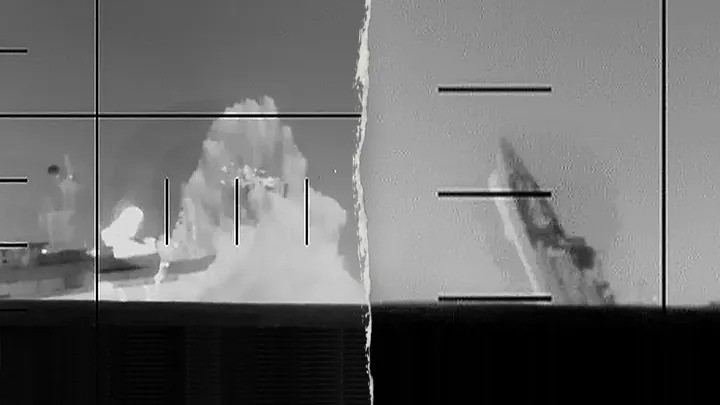
In a dramatic escalation of military operations against Iran, a United States submarine has successfully sunk the Iranian Navy's flagship using a torpedo, marking the first such sinking of an enemy vessel since World War II, Defense Secretary Pete Hegseth announced Wednesday morning.
Historic Naval Strike Sends Soleimani to Ocean Floor
The attack targeted and destroyed the Iranian Navy's flagship vessel, the Soleimani, in what Secretary Hegseth described as a "quiet death" delivered by American submarine forces operating in international waters in the Indian Ocean.
"An American submarine sunk an Iranian warship that thought it was safe in international waters," Hegseth told reporters during a Pentagon briefing. "Instead, it was sunk by a torpedo. Quiet death. The first sinking of an enemy ship by a torpedo since World War Two."
The Iranian warship was named after Qasem Soleimani, the Iranian military commander killed by a U.S. drone strike in January 2020 during President Donald Trump's first term. The symbolic significance was not lost on Hegseth, who remarked, "Looks like POTUS got him twice."
Single Mark 48 Torpedo Delivers Devastating Blow
Chairman of the Joint Chiefs of Staff Gen. Dan Caine provided tactical details of the operation during the briefing, describing how the Iranian vessel was "effectively neutralized" in what he characterized as a Navy "fast attack" using a single Mark 48 torpedo.
"The U.S. Navy achieved immediate effect, sending the warship to the bottom of the sea," Caine stated, emphasizing the precision and lethality of the submarine strike.
The Mark 48 torpedo represents one of the most sophisticated weapons in the U.S. Navy's arsenal, designed specifically for submarine warfare and capable of tracking and destroying both surface ships and other submarines at considerable distances.
Iranian Navy "Combat Ineffective"
Hegseth delivered a sweeping assessment of Iran's naval capabilities following days of intense military operations, declaring the Iranian Navy effectively destroyed as a fighting force.
"The Iranian Navy rests at the bottom of the Persian Gulf. Combat ineffective, decimated, destroyed, defeated. Pick your adjective," the Defense Secretary stated emphatically. "Their navy, not a factor. It is no more."
The sinking of the Soleimani represents the most prominent naval kill in what Hegseth characterized as a comprehensive degradation of Iran's maritime forces throughout the Persian Gulf region.
Complete Air Superiority Within Days
Beyond the submarine attack, Hegseth outlined the broader scope of Operation Epic Fury, revealing that U.S. and Israeli forces are on the verge of achieving total air superiority over Iranian territory.
"More bombers and more fighters are arriving just today and now, with complete control of the skies, we will be using 500 pound, one thousand pound and 2,000 pound laser-guided precision gravity bombs, of which we have a nearly unlimited stockpile," Hegseth announced.
The shift to conventional gravity bombs indicates that coalition forces have successfully suppressed Iranian air defenses to the point where aircraft can operate with relative impunity over Iranian territory—a dramatic change from the opening days of the conflict when sophisticated surface-to-air missile systems posed significant threats to attacking aircraft.
Mounting Casualties and Regional Impact
The rapid military campaign has exacted a heavy toll across the region. According to U.S. officials, more than 1,000 people have been killed in Iran, with dozens more casualties reported in Lebanon as the conflict spreads beyond Iranian borders.
American forces have also paid a price for the operation. Six U.S. troops were killed in a drone strike in Kuwait, underscoring the dangers faced by American military personnel even in locations previously considered relatively secure.
Gen. Caine confirmed that the U.S. military is actively assisting thousands of Americans who have become stranded across the Middle East following the State Department's urgent advisories for U.S. citizens to leave more than a dozen countries in the region.
Significance of Torpedo Warfare Return
The successful torpedo attack marks a remarkable moment in naval warfare history. The last time a U.S. submarine sank an enemy vessel with a torpedo was during World War II, when American submarines played a crucial role in the Pacific theater, devastating the Japanese merchant marine and naval forces.
Modern submarine warfare had evolved primarily toward launching cruise missiles and conducting intelligence gathering operations. The return to torpedo attacks against surface vessels represents a shift back to a more traditional submarine warfare role, demonstrating the versatility and lethality of America's submarine fleet.
The attack also highlights the vulnerability of surface warships to modern submarine threats, even in an era dominated by advanced sensors and anti-submarine warfare technology. The fact that the Soleimani was operating in international waters and still fell victim to an American submarine underscores the stealth capabilities of U.S. naval forces.
Strategic Implications
The destruction of Iran's flagship and the broader degradation of its naval forces fundamentally alters the strategic balance in the Persian Gulf. Iranian naval power has historically served as one of Tehran's primary tools for threatening international shipping through the strategically vital Strait of Hormuz, through which roughly one-fifth of the world's oil supply passes.
With Iranian naval capabilities effectively neutralized, the regime has lost a major lever of influence over global energy markets and regional security. This may limit Tehran's options for responding to the ongoing military campaign or for deterring future actions by the United States and its allies.
Operation Epic Fury Objectives
While the full scope and ultimate objectives of Operation Epic Fury remain unclear, the rapid pace and overwhelming force of the campaign suggest the Trump administration is pursuing maximalist goals against the Iranian regime.
The operation appears designed not merely to punish Iran for specific provocations but to fundamentally degrade the country's military capabilities across multiple domains—naval, air, and ground forces. The systematic destruction of Iranian naval assets, the suppression of air defenses, and the targeting of military leadership all point to an effort to cripple Iran's capacity to project power regionally.
The timing of the operation, coming amid widespread protests against the Iranian regime and following years of escalating tensions, suggests the administration sees an opportunity to deliver a decisive blow to a government already facing significant internal and external pressures.
International Response and Regional Stability
The dramatic escalation of military action against Iran raises questions about the broader regional implications and international response. While specific details about diplomatic reactions remain limited, the scale and intensity of the operation will likely prompt responses from various international actors with interests in Middle Eastern stability.
The conflict's expansion and the growing humanitarian toll, combined with the disruption to international travel and commerce throughout the region, present significant challenges for governments attempting to protect their citizens and economic interests in the area.
As Operation Epic Fury continues to unfold, the historic submarine attack on the Soleimani stands as a defining moment—both as a tactical victory and as a symbol of American military power projection in one of the world's most strategically important regions.
© 2026 HNGN, All rights reserved. Do not reproduce without permission.