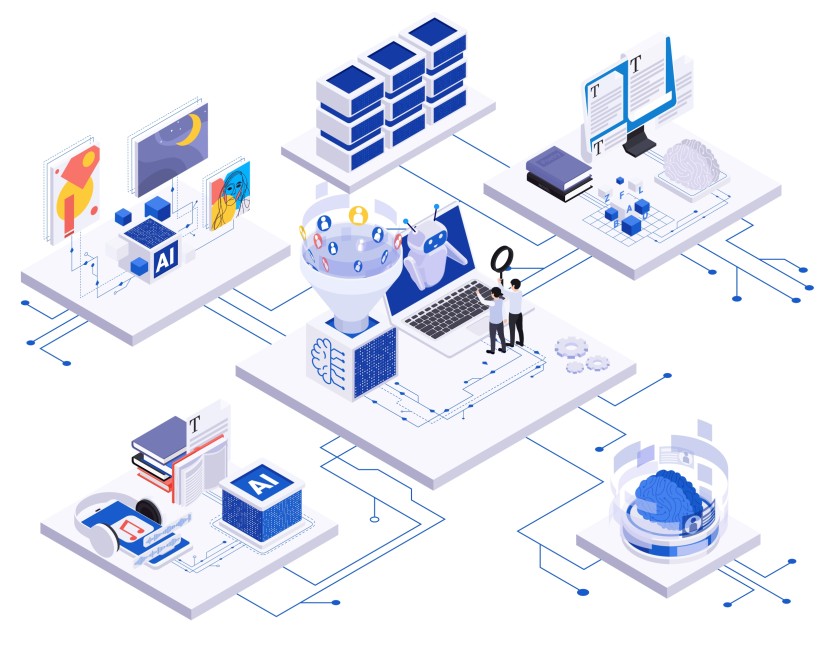
Artificial Intelligence, often shortened to AI, has become one of the most influential technologies of the 21st century. From smartphones and self-driving cars to medical breakthroughs and creative tools, AI is rapidly reshaping the way humans live, work, and interact with the world. What once sounded like science fiction is now an everyday reality.
This article explores what AI is, how it works, where it is being used today, and what challenges and opportunities it brings for the future.
What Is Artificial Intelligence?
Artificial Intelligence refers to the ability of machines and computer systems to perform tasks that normally require human intelligence. These tasks include:
- Learning from experience
- Recognizing patterns
- Understanding language
- Solving problems
- Making decisions
- Generating content
AI systems are designed to simulate aspects of human thinking, but they do so through algorithms, data, and computational power rather than emotions or consciousness.
A Brief History of AI
The concept of AI dates back decades. In the 1950s, scientists began asking whether machines could "think." Early AI research focused on logic and problem-solving, but progress was slow due to limited computing resources.
Major breakthroughs occurred in the 2000s and 2010s, when:
- Massive amounts of data became available
- Computers became much faster
- Machine learning models improved significantly
Today, AI is advancing at an unprecedented pace, with systems capable of writing, drawing, coding, diagnosing diseases, and more.
How AI Works: Machine Learning and Deep Learning
Most modern AI is powered by machine learning, a method where computers learn patterns from data rather than being explicitly programmed.
Machine Learning
Machine learning models improve over time as they process more examples. For instance, an AI trained on thousands of images of cats can learn to identify cats in new pictures.
Deep Learning
Deep learning is a more advanced form of machine learning that uses neural networks inspired by the human brain. Deep learning powers technologies like:
- Voice assistants
- Facial recognition
- Language translation
- Generative AI tools
Everyday Applications of AI
AI is already deeply embedded in daily life, often in ways people don't even notice.
1. Healthcare
AI is helping doctors detect diseases earlier, analyze medical scans, and develop personalized treatment plans.
2. Education
AI tutors can adapt lessons to individual learning styles, helping students learn faster and more effectively.
3. Business and Finance
Companies use AI for:
- Fraud detection
- Customer service chatbots
- Predicting market trends
- Automating repetitive tasks
4. Entertainment and Creativity
AI can generate music, artwork, video scripts, and even entire films. This has sparked both excitement and debate over creativity and originality.
5. Transportation
Self-driving technology and smart traffic systems rely heavily on AI to improve safety and efficiency.
The Growing Role of Generative AI
One of the most talked-about developments today is generative AI, which can create content such as:
- Articles
- Images
- Code
- Poems
- Marketing materials
Tools like ChatGPT and other large language models have made AI accessible to millions of people, transforming industries and workflows.
However, this rise has also created new concerns, especially regarding authenticity and misinformation.
AI Detectors and the Question of Authenticity
As AI-generated writing becomes more common, many schools, businesses, and publishers have begun using an AI detector to determine whether a piece of content was written by a human or produced by AI.
An AI detector works by analyzing patterns in language, sentence structure, predictability, and style. These tools aim to prevent misuse, such as:
- Academic cheating
- Fake news generation
- Automated spam content
However, AI detectors are not always accurate. Human writing can sometimes be flagged incorrectly, while AI writing can sometimes pass unnoticed. This highlights an important challenge: as AI improves, distinguishing between human and machine content becomes increasingly difficult.
Ethical Challenges of AI
While AI brings enormous benefits, it also raises serious ethical and societal concerns.
Bias and Fairness
AI systems can inherit biases from the data they are trained on, leading to unfair outcomes in hiring, policing, or lending decisions.
Privacy
AI surveillance and data tracking raise questions about how personal information is collected and used.
Job Displacement
Automation powered by AI may replace certain jobs, especially those involving repetitive tasks. At the same time, it will also create new roles in technology and innovation.
Misinformation
AI can generate convincing fake content, making it harder to trust what we see and read online.
The Future of AI
The future of AI is both exciting and uncertain. Experts predict AI will continue to evolve and influence nearly every industry. Possible future developments include:
- More advanced medical AI systems
- Fully autonomous transportation
- AI-powered scientific discovery
- Personalized digital assistants for everyone
The key will be ensuring AI is developed responsibly, with strong regulations and ethical oversight.
Conclusion
Artificial Intelligence is one of the most powerful technologies ever created. It has the potential to solve global problems, enhance human creativity, and improve the quality of life. At the same time, it introduces complex challenges involving trust, fairness, and accountability.
As AI becomes more integrated into society, tools like the AI detector will play a role in navigating the line between human and machine-generated work. Ultimately, the future of AI depends not only on technological progress but also on the choices humanity makes in guiding its development.
© 2026 HNGN, All rights reserved. Do not reproduce without permission.


