Days after the United States captured Venezuelan President Nicolás Maduro and his wife, Celia Flores, during an operation in Caracas on Jan. 3, the Venezuelan government staged a show in the capital's skies with the intention of demonstrating support and demanding the couple's release.
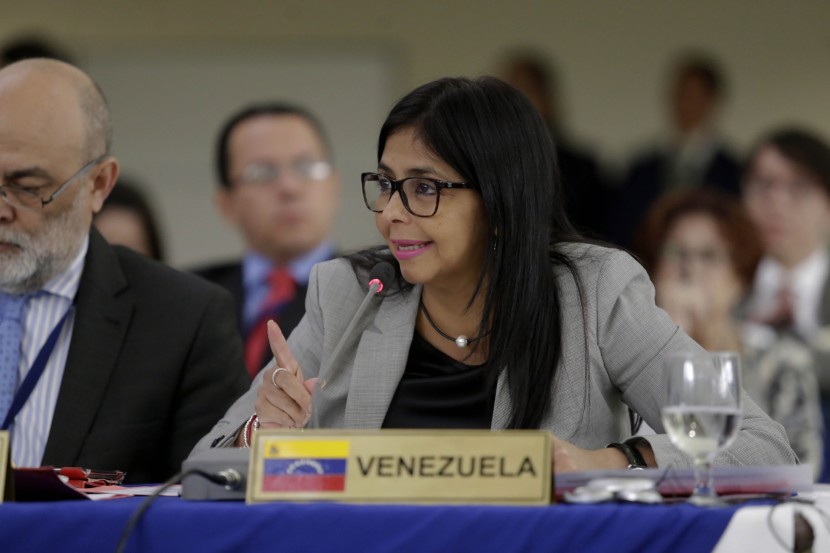
With thousands of drones lighting up the sky, the message from the interim government of Delcy Rodríguez was clear: continue publicly backing Maduro and the socialist regime that has ruled Venezuela for decades. Since being appointed interim leader, Rodríguez has also had to implement changes under pressure from the Trump administration, which has warned she could suffer the same fate as Maduro if she does not comply.
In a new report by the BBC, experts said that despite Rodríguez's difficult position, she has so far managed to navigate pressure from both sides while keeping each satisfied, at least for now. That balance, however, could shift at any moment given the intense pressure the United States is placing on Venezuela.
"Rodríguez's legitimacy lies in the military strength of the U.S. And it will last if Trump wants it to. She cannot stand up to him," Carmen Beatriz Fernández, a Venezuelan political analyst and CEO of DataStrategia, a political consultancy firm, told the BBC.
In Caracas, banners supporting Maduro while denouncing U.S. intervention have become common across the city. At the same time, Rodríguez has organized pro-government marches in the capital featuring large public displays demanding Maduro's return.
"She is handling communication in the best possible way and establishing guidelines for the country to continue moving forward despite the hijacking," Leonardo Arca, 39, a civil servant, told the BBC during a small pro-government march in Caracas last month.
Despite being a Maduro loyalist and a lifelong Chavista, Rodríguez has deviated significantly from some of the regime's previous policies. She passed a law paving the way for U.S. oil companies to begin operating in Venezuela and authorized the release of numerous politicians and human rights activists who had been imprisoned for months or years.
Although the Venezuelan opposition argues that many of Rodríguez's changes occurred only because of U.S. pressure, she appears to have gained Trump's trust. He has publicly referred to Rodríguez as "a wonderful person" and "someone we have worked very well with."
More recently, he acknowledged the diplomatic bind Rodríguez faces. When asked about her statement that Maduro remains the legitimate president, Trump dismissed it, saying: "I think she probably has to say that."
Despite maintaining a working relationship with U.S. officials, Rodríguez has criticized the Jan. 3 operation and expressed opposition to what she described as U.S. expansionism. But Phil Gunson, a senior analyst at the International Crisis Group think tank based in Caracas, told the BBC that her public criticism of Washington is strategic.
"Washington must understand that she must continue with this rhetoric. It is a way of maintaining cohesion in the Chavista project, even though it is known that it is not real," Gunson said.
Beyond balancing her relationship with Trump and managing domestic expectations, Rodríguez has also had to navigate her relationship with Interior Minister Diosdado Cabello, who wields significant influence within the military, which has remained loyal to Maduro.
"There's a theory that they're playing good-cop, bad-cop," Sabatini said. "She knows she needs him to maintain the security forces and keep them on her side ... but as long as they don't interfere with her momentum of attracting investors and most elements of the Trump administration, he serves her purpose."
As Sabatini noted, Rodríguez has managed the situation she inherited and may have more leverage with Trump than what initially meets the eye.
"Trump wants to see Venezuela continue on the path it's on; he doesn't want anything to contradict the narrative that everything is fine. Trump doesn't want to see the oil hit the fan, so to speak. So she has some leverage over Trump, which most people don't realize. She's not just a secondary partner. It's more of an equal partnership than Trump would like," the expert added.
Originally published on Latin Times
© 2025 Latin Times. All rights reserved. Do not reproduce without permission.


