President Donald Trump issued his most explicit military threat against Iran yet on Wednesday, announcing that a "massive armada" led by the USS Abraham Lincoln aircraft carrier is heading toward the Islamic Republic and warning that the next attack will be "far worse" than the June strikes that destroyed three major Iranian nuclear facilities.
In a lengthy post on Truth Social, Trump demanded Iran immediately negotiate an agreement to end its nuclear program or face devastating military consequences. The threat marks a dramatic escalation in tensions following Iran's brutal crackdown on mass protests that may have killed thousands of civilians.
"A massive Armada is heading to Iran. It is moving quickly, with great power, enthusiasm, and purpose," Trump wrote Wednesday morning. "It is a larger fleet, headed by the great Aircraft Carrier Abraham Lincoln, than that sent to Venezuela. Like with Venezuela, it is ready, willing, and able to rapidly fulfill its mission, with speed and violence, if necessary."
Ultimatum: Deal or Destruction
Trump's message combined diplomatic overture with explicit military menace, giving Iran a stark choice between negotiation and confrontation. "Hopefully Iran will quickly 'Come to the Table' and negotiate a fair and equitable deal — NO NUCLEAR WEAPONS — one that is good for all parties," the president posted. "Time is running out, it is truly of the essence! As I told Iran once before, MAKE A DEAL!"
The warning referenced Operation Midnight Hammer, the controversial June 2025 military operation in which U.S. warplanes joined Israel in attacking three Iranian nuclear facilities during a 12-day conflict. Trump claimed the strikes "obliterated" Iran's nuclear capacity, though the true extent of damage and the current status of Iran's nuclear program remain subjects of intense debate.
"They didn't, and there was 'Operation Midnight Hammer,' a major destruction of Iran," Trump continued. "The next attack will be far worse! Don't make that happen again."
According to various reports, the June attacks killed approximately 430 people at the nuclear sites. Iranian officials have repeatedly vowed a "comprehensive and regret-inducing response" if attacked again, while the whereabouts of Iran's highly enriched uranium stockpiles have remained unknown since the strikes.
Military Deployment and Capabilities
The USS Abraham Lincoln carrier strike group entered Middle Eastern waters on Tuesday, confirmed by U.S. Central Command. The deployment includes the Nimitz-class aircraft carrier along with several guided missile destroyers, giving the administration significant strike capabilities against targets throughout Iranian territory.
Beyond the carrier group, the Pentagon has deployed additional F-15 and F-35 fighter jets, aerial refueling tankers, and advanced air defense systems to the region. CENTCOM Commander Admiral Brad Cooper visited Israel over the weekend to discuss joint military planning, signaling coordination between Washington and Tel Aviv on potential operations.
Trump repeatedly emphasized the size and power of the naval force during public appearances. Speaking in Iowa on Tuesday evening, he described "another beautiful armada floating beautifully towards Iran right now," comparing it favorably to the naval buildup that preceded the recent capture of Venezuelan leader Nicolas Maduro.
The military positioning gives Trump multiple options for potential strikes, from limited attacks on specific targets to broader campaigns against Iran's military infrastructure, nuclear facilities, or leadership. However, administration officials remain divided on whether and how to use force, according to multiple reports.
Context: Protests, Crackdown, and Casualties
The immediate trigger for Trump's escalated threats was Iran's violent suppression of nationwide protests that erupted on December 28, 2025, over the collapse of the Iranian rial currency and rapidly rising costs of living. What began as economic grievances quickly expanded into broader demonstrations against Iran's theocratic government.
Iranian security forces responded with overwhelming force, deploying live ammunition against protesters and conducting mass arrests. The confirmed death toll has reached at least 5,848 people according to the Human Rights Activists News Agency (HRANA), with an additional 17,091 deaths still under investigation. Some reports suggest the total casualties could exceed 30,000, making this the deadliest period of civil unrest in Iran since the 1979 Islamic Revolution.
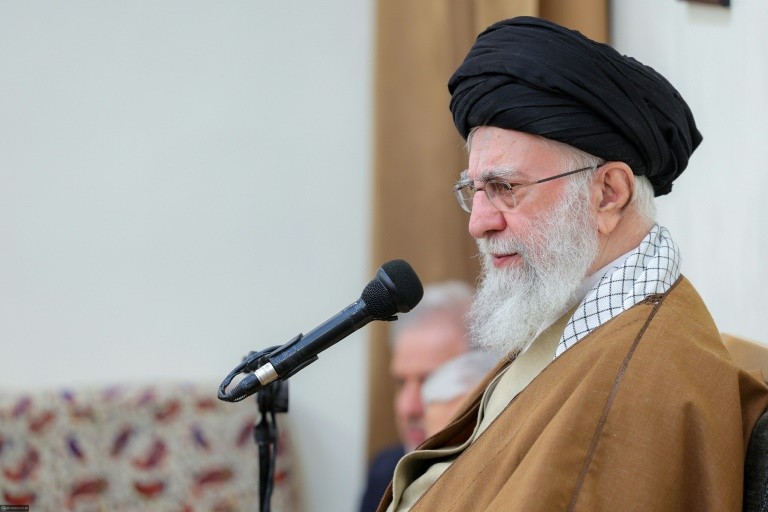
Nearly 42,000 people have been detained, with authorities threatening mass executions. Iran's Supreme Leader Ayatollah Ali Khamenei has reportedly taken shelter in a fortified underground facility amid the chaos, according to Iranian exile media outlets.
Trump initially threatened military action earlier in January if Iran "violently kills" protesters or conducts mass executions of detainees. He subsequently claimed his warnings had led to a temporary de-escalation, though the violence continued. Last week, the president announced that an "armada" was heading toward Iran but expressed hope he wouldn't need to use it.
"We have a lot of ships going that direction just in case," Trump told reporters Thursday. "We have an armada heading that direction and maybe we won't have to use it."
Wednesday's statement represented the first time Trump explicitly linked the major naval deployment to stalled nuclear negotiations rather than solely to the protest crackdown.
Iranian Response: Defiance and Warnings
Iran's mission to the United Nations responded defiantly to Trump's threats on Wednesday, posting on social media that Tehran "stands ready for dialogue based on mutual respect and interests—BUT IF PUSHED, IT WILL DEFEND ITSELF AND RESPOND LIKE NEVER BEFORE!"
The mission added pointed commentary about past American military interventions: "Last time the U.S. blundered into wars in Afghanistan and Iraq, it squandered over $7 trillion and lost more than 7,000 American lives."
Iranian Foreign Minister Abbas Araghchi said Wednesday that he had not been in contact with U.S. special envoy Steve Witkoff in recent days and had not requested negotiations, according to Reuters citing Iranian state media. This contradicted Trump's claims that Iran has been calling "on numerous occasions" seeking talks.
However, Araghchi also stated he was in "continuous contact" with counterparts in other regional countries, suggesting diplomatic efforts to build support or deter American military action. Iran's army commander, Rear Admiral Habibollah Sayyari, reiterated that Iranian forces stand ready to confront any threat.
"The Islamic Republic of Iran Army is always ready to confront any threat, and if anything happens, the enemy will certainly suffer severe damage," Sayyari said Wednesday. "We stand against any threat on land, in the air, and at sea."
General Mohammad Pakpour of Iran's Islamic Revolutionary Guard Corps issued stern warnings over the weekend that neighboring countries would be "considered hostile" if their territory is used by the United States during any attack. Both Tehran and the U.S. Air Force have announced military drills near the critical Strait of Hormuz, through which roughly 20% of global oil supplies pass.
Regional Diplomatic Implications
The confrontation has sparked intense diplomatic activity across the Middle East. Saudi Arabia and the United Arab Emirates, both of which host U.S. military forces, have reportedly signaled they will not allow their airspace to be used for any attack on Iran. This echoes the complex regional dynamics that limited American military options during previous confrontations.
In June 2025, Iran responded to the bombing of its nuclear facilities with an attack on U.S. forces stationed at Al Udeid Air Base in Qatar, demonstrating its willingness and capability to strike American assets throughout the region. The memory of that escalation weighs heavily on current calculations about potential conflict.
Turkey's Foreign Minister Hakan Fidan suggested to Al Jazeera on Wednesday that "Iran is ready to negotiate a nuclear file again," contradicting Iranian officials' public statements but potentially indicating behind-the-scenes diplomatic feelers.
The regional powers face difficult choices: supporting the United States risks retaliation from Iran and its proxies across the Middle East, while opposing Washington could damage critical security partnerships and access to American military protection.
Nuclear Negotiations: History and Demands
The current crisis represents the latest chapter in a decades-long international effort to limit Iran's nuclear program. The United States withdrew from the Joint Comprehensive Plan of Action (JCPOA)—the 2015 multinational nuclear agreement—during Trump's first term, reimposing harsh sanctions and pursuing a "maximum pressure" campaign.
Trump has said he wants to negotiate a new deal that goes far beyond the JCPOA's restrictions. Washington's current demands reportedly include requiring Iran to eliminate all enriched uranium stockpiles, cap its ballistic missile arsenal, cease support for regional proxy forces like Hezbollah and Hamas, and abandon independent uranium enrichment capabilities.
Iranian officials have consistently rejected these terms as violations of their sovereignty and national security interests. Tehran insists its nuclear program serves purely civilian purposes—power generation and medical isotope production—and that it has the right under international law to enrich uranium.
U.S. special envoy Steve Witkoff and Iranian Foreign Minister Araghchi led five rounds of mostly indirect nuclear negotiations between Washington and Tehran earlier in 2025. Those talks broke down in June as Israel launched its 12-day war against Iran, which included the American airstrikes on nuclear facilities.
Trump has repeatedly claimed that Iran was "about a month away from having a nuclear weapon" before the June attacks, though international nuclear inspectors and Western intelligence agencies have offered varying assessments of how close Iran actually came to weapons capability.
Administration Internal Divisions
Multiple reports indicate significant disagreement within the Trump administration about how to proceed. Some officials have advocated for enforcing the president's stated "red lines" regarding protester deaths and mass executions, arguing that credibility requires following through on threats. Others question what strategic objectives military strikes would accomplish beyond the immediate tactical damage.
The June attacks clearly did not end Iran's nuclear program, as evidenced by ongoing American demands for negotiations. Critics argue that another round of strikes might similarly fail to achieve lasting strategic gains while risking broader regional war and creating unpredictable consequences.
Trump himself has sent mixed signals, alternating between bellicose threats and expressions of hope for diplomatic resolution. On Monday, he told Axios that he believes Iran's leaders want to negotiate: "They want to make a deal. I know so. They called on numerous occasions. They want to talk."
The president also described the situation as "in flux," suggesting decisions about military action remain under active deliberation. White House officials confirmed to Axios that an attack remains "on the table" as Trump holds further consultations this week.
Economic and Security Considerations
Beyond the immediate military and diplomatic dimensions, the Iran crisis carries significant economic implications. Iran has previously threatened to close the Strait of Hormuz in response to military attacks, which would disrupt global oil markets and spike energy prices worldwide.
The potential for broader regional conflict affecting critical infrastructure, shipping lanes, and allied nations creates economic risks extending far beyond the Middle East. American businesses with regional interests and global corporations dependent on energy security face uncertainty about potential disruptions.
For American universities and research institutions, escalating Middle East tensions affect international student recruitment, faculty exchanges, and collaborative research projects. Iranian students and scholars face particular challenges, while institutions across the region navigate security concerns and diplomatic pressures.
The specter of military conflict also influences markets and investor confidence, as uncertainty about major geopolitical developments affects risk assessments and capital allocation decisions.
Looking Ahead: Escalation or Negotiation?
As the USS Abraham Lincoln carrier group settles into position within striking distance of Iran, the world watches to see whether Trump's threats lead to diplomatic breakthrough or military confrontation. The president has set a pattern of public ultimatums followed by either strikes (as in June) or claims of success in deterring bad behavior (as with the protest crackdown).
Iran faces its own difficult calculations. Its economy already suffers under comprehensive American sanctions, domestic stability has been shaken by massive protests, and military confrontation with the United States offers no clear path to victory. Yet backing down under explicit threats could undermine the regime's legitimacy and embolden future challenges.
The coming days and weeks will reveal whether this crisis follows the path toward military escalation or whether diplomatic channels—public or private—can find a resolution that allows both sides to step back from the brink.
For now, a massive American armada sits in Middle Eastern waters, Iranian forces prepare for potential attack, regional powers scramble to avoid being caught in the crossfire, and the world confronts the possibility of another major military conflict in one of its most volatile and strategically critical regions.
© 2026 HNGN, All rights reserved. Do not reproduce without permission.