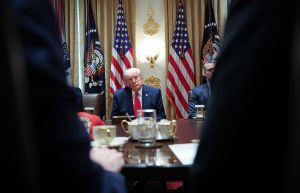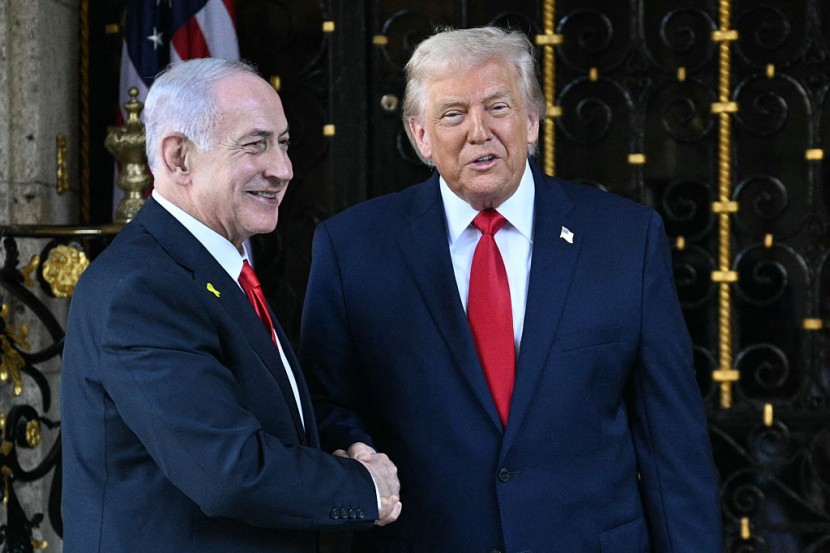
U.S. President Donald Trump reportedly lashed out at Israeli Prime Minister Benjamin Netanyahu in a heated phone call over Israel's escalation of military action in Lebanon.
Citing two U.S. officials and another source briefed on the conversation, Axios reported Monday that Trump used strong language while criticizing Netanyahu for actions that could jeopardize Washington's efforts to secure a preliminary peace agreement with Iran.
"You'd be in prison if it weren't for me," a U.S. official told the news outlet Trump said to the Israeli leader. "I'm saving your ass. Everybody hates you now. Everybody hates Israel because of this."
Another source briefed on the call told Axios that the U.S. President was "pissed" and at one point yelled to Netanyahu, "What the f-ck are you doing?"
Beirut Strike Raises Concerns Over Iran Negotiations
The reported confrontation came after Netanyahu ordered an attack on a Hezbollah stronghold in Beirut in response to alleged attacks on Israel by the Lebanese militant group.
Trump appeared to send mixed signals Monday regarding the future of U.S.-Iran negotiations. During a public interview, he said he "couldn't care less" if talks collapsed. However, he later wrote on Truth Social that negotiations were "continuing, at a rapid pace," reported Time.
According to Iran's semi-official Tasnim news agency, Tehran was prepared to suspend talks with Washington following the Israeli strike in Beirut.
Iranian officials argued that Israeli military actions in Lebanon violated the broader ceasefire framework established between the United States and Iran in April.
"The ceasefire between Iran and the U.S. is unequivocally a ceasefire on all fronts, including in Lebanon," Iranian Foreign Minister Abbas Araghchi posted on X,"Its violation on one front is a violation of the ceasefire on all fronts. The U.S. and Israel are responsible for the consequences of any violation."
For immediate attention:
— Seyed Abbas Araghchi (@araghchi) June 1, 2026
The ceasefire between Iran and the US is unequivocally a ceasefire on all fronts, including in Lebanon.
Its violation on one front is a violation of the ceasefire on all fronts.
The US and Israel are responsible for the consequences of any violation.
Hezbollah, an Iranian-backed militant group based in Lebanon, has been engaged in a prolonged conflict with Israel. Fighting intensified following the Oct. 7, 2023 attacks and the subsequent war in Gaza.
Despite a ceasefire reached in November 2024 and another ceasefire agreement in April 2026, hostilities between Israel and Hezbollah have continued.
Temporary Ceasefire Proposal Emerges
Despite the reportedly tense exchange, Trump later described the conversation as "very productive" in a post on Truth Social. He added that "there will be no Troops going to Beirut and any Troops that are on their way have already turned back."
The U.S. president said he had also spoken with representatives of Hezbollah and that both sides agreed not to attack one another.
Later Monday, the Lebanese Embassy in Washington issued a statement saying Hezbollah had accepted a U.S.-backed proposal calling for "a reciprocal cessation of attacks."
Under the proposal, the embassy said, "Israeli strikes on Beirut's southern suburbs would cease in exchange for Hezbollah refraining from carrying out attacks against Israel, with the ceasefire framework to be expanded to encompass all Lebanese territories."
The embassy further stated that Trump personally contacted Lebanon's ambassador to the United States to inform her that Netanyahu had agreed to the arrangement.
Netanyahu Signals Continued Military Operations
Netanyahu, however, signaled that Israel would continue military operations in southern Lebanon.
In a social media post, the Israeli prime minister said Israeli forces would continue to operate "as planned" and revealed that he told Trump, "if Hezbollah does not cease attacking our cities and citizens—Israel will attack terror targets in Beirut."
ABC News reported that Trump acknowledged that tensions had briefly threatened diplomatic progress. He said, "there was a little glitch today, but I turned that one around very quickly."
The developments underscore growing tensions between Washington and Jerusalem as the United States attempts to preserve diplomatic momentum with Iran while preventing renewed conflict across the Israel-Lebanon border.
© 2026 HNGN, All rights reserved. Do not reproduce without permission.