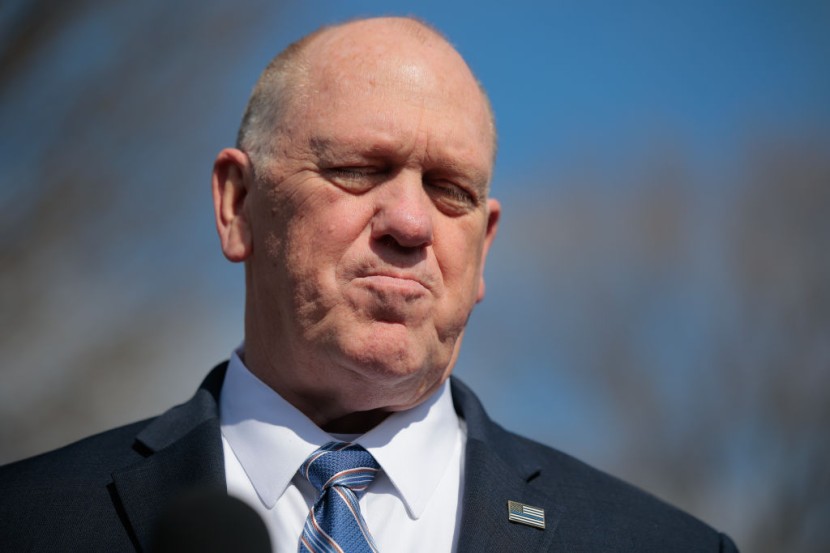
White House border czar Tom Homan announced Wednesday morning an immediate withdrawal of 700 federal immigration enforcement agents from Minnesota, crediting what he described as "unprecedented cooperation" from local law enforcement that makes the massive federal presence unnecessary.
The announcement, delivered during a press conference at the Bishop Henry Whipple Federal Building in Minneapolis, marks a significant de-escalation in federal immigration operations that have roiled the Twin Cities for weeks with high-profile arrests, organized protests, and two fatal shootings of civilians by federal agents.
"Given this increase in unprecedented collaboration, and as a result of less need for law enforcement officers to do this work in a safer environment, I have announced immediately we will draw down 700 people effective today," Homan said Wednesday, adding that the ultimate goal remains a "complete drawdown" of federal presence in Minnesota.
Shift in Local Law Enforcement Cooperation
The drawdown announcement followed what Homan characterized as a dramatic shift in cooperation from Minnesota counties and local jails. He emphasized that numerous counties have begun notifying Immigration and Customs Enforcement when they plan to release detained individuals who are in the country illegally, allowing ICE to take custody before those individuals return to the community.
"We currently have an unprecedented number of counties communicating with us now and allowing ICE to take custody of illegal aliens before they hit the streets," Homan stated. "I'll say it again: This is efficient, and it requires only one or two officers to assume custody of a criminal alien target, rather than eight or 10 officers going into the community and arresting that public safety threat."
This cooperation model contrasts sharply with the large-scale street operations that characterized federal enforcement efforts in recent weeks. Those operations frequently involved teams of agents conducting neighborhood sweeps, generating confrontations with protesters and raising concerns about collateral arrests of individuals not targeted for deportation.
Homan met with Minnesota Governor Tim Walz, Attorney General Keith Ellison, and Minneapolis Mayor Jacob Frey to discuss the new approach. He urged all three officials to encourage local jails to communicate with federal authorities about release schedules for detained immigrants, emphasizing that cooperation benefits everyone involved.
"We're not asking anyone to be an immigration officer," Homan clarified, addressing concerns that counties might be required to hold individuals beyond their normal release times or perform immigration enforcement duties themselves. The federal request simply involves notification when someone flagged in immigration databases will be released from county custody.
Safety and Efficiency Arguments
Homan repeatedly emphasized that the jail-based custody transfer model proves safer for officers, communities, and immigrants themselves compared to street arrests. Taking custody at a secure facility eliminates many risks associated with enforcement operations in residential neighborhoods, including potential confrontations with family members, bystanders, or organized protesters.
The border czar framed the new cooperation as a win across the board: more efficient use of federal resources, reduced disruption to Minnesota communities, safer conditions for law enforcement, and fewer opportunities for the chaotic confrontations that have characterized recent weeks.
However, critics have argued that the cooperation Homan describes essentially deputizes local law enforcement for federal immigration enforcement, raising questions about trust between immigrant communities and local police. Civil rights advocates worry that immigrants will avoid reporting crimes or cooperating with investigations if they fear local jails will turn them over to ICE.
Context: Tense Weeks of Federal Operations
The drawdown announcement comes after a turbulent period that saw thousands of federal agents deployed to the Twin Cities area as part of what the administration has called enhanced immigration enforcement. The operation followed conservative media attention to allegations of daycare fraud involving Somali immigrants, though the administration cited broader enforcement priorities.
The federal presence escalated dramatically following two fatal shootings by federal agents. In January, agents shot and killed Renee Good, a mother of three and U.S. citizen, in her car. Weeks later, agents fatally shot Alex Pretti, a 37-year-old ICU nurse and anti-ICE protester, on a Minneapolis street. Both incidents sparked widespread protests and intensified criticism of federal tactics.
President Donald Trump deployed Homan to Minneapolis last week specifically to address the crisis. U.S. Border Patrol commander Gregory Bovino, who had been overseeing operations, left Minnesota shortly after Homan's arrival, signaling a change in federal strategy.
Federal agents faced organized resistance throughout their operations, with groups of protesters tracking enforcement activities and intervening to obstruct arrests. These confrontations created tense standoffs and generated viral social media videos showing civilians blocking federal vehicles and forming human chains around targeted individuals.
Republicans on Capitol Hill have called for investigations into funding streams behind the organized protest movement, suggesting coordination and financial support from progressive advocacy organizations.
Political Dimensions and Reactions
The announcement represents a political victory for the Trump administration, allowing Homan to declare mission accomplished while crediting cooperation rather than force for achieving enforcement objectives. It also provides Minnesota officials with an off-ramp from a situation that had become increasingly untenable politically and operationally.
Governor Walz, Attorney General Ellison, and Mayor Frey had all pressed for ICE to cease aggressive operations in Minneapolis while stopping short of the blanket non-cooperation policies enacted by some other Democratic-led jurisdictions. The new arrangement allows them to claim they protected immigrant communities while also maintaining working relationships with federal law enforcement.
Minneapolis Mayor Jacob Frey had announced plans to visit Washington to push for an end to what he called "unlawful ICE operations." Wednesday's announcement may alter those plans or the substance of those discussions, though Frey's office had not immediately commented on Homan's press conference.
The drawdown also comes as federal courts in Minnesota have sharply criticized immigration authorities for failing to comply with judicial orders. Chief U.S. District Judge Patrick Schiltz recently threatened to hold acting ICE Director Todd Lyons in contempt for violating "dozens of court orders" related to detained immigrants, demanding Lyons appear personally to explain the violations.
Implementation Questions
While Homan announced the immediate departure of 700 agents, significant details remain unclear. The announcement did not specify the total number of federal agents currently deployed in Minnesota, making it difficult to assess what percentage are leaving and how many will remain.
The goal of "complete drawdown" suggests an eventual return to normal staffing levels for ICE operations in the region, though no timeline was provided. Whether this represents days, weeks, or months of continued federal presence remains uncertain.
Questions also persist about how the new cooperation model will work in practice. Which specific counties have agreed to notify ICE about releases? How will that information be shared? What happens if counties change their policies? Will the reduced federal presence continue immigration enforcement operations, just at lower intensity?
The administration has not publicly addressed whether ongoing court challenges or the contempt proceedings against Lyons influenced the timing of the drawdown announcement.
Broader Immigration Enforcement Landscape
Minnesota represents just one front in the Trump administration's expanded immigration enforcement efforts. Similar large-scale operations have occurred or are planned in other cities, though few have generated the level of protest activity and fatal shootings seen in the Twin Cities.
The Minnesota experience may influence how the administration approaches enforcement in other Democratic-led cities and states. If cooperation can be achieved through negotiation with state and local officials rather than confrontational street operations, that model might prove more sustainable politically and legally.
However, the unique circumstances in Minnesota—including the specific allegations that triggered initial federal attention, the particular political dynamics, and the tragedy of civilian deaths by federal agents—may limit how much can be generalized from this case to other jurisdictions.
Impact on Immigrant Communities and Universities
The federal immigration enforcement operations have created climate of fear in Minnesota's immigrant communities, affecting daily life, economic activity, and community engagement. Many immigrants have avoided public spaces, missed work, or kept children home from school out of concern about enforcement operations.
Universities with significant international student populations have grappled with how to support and protect their communities while navigating complex legal obligations. Faculty and researchers on work visas expressed concerns about traveling or conducting field research during periods of heightened enforcement.
The drawdown may ease some of these tensions, though the underlying uncertainty about immigration policy and enforcement priorities remains. The new cooperation model between local jails and ICE may shift the specific risks faced by immigrant communities without necessarily reducing overall enforcement levels.
Looking Forward
As 700 federal agents prepare to leave Minnesota, attention turns to whether the new cooperative model will prove durable and effective. Local officials must navigate competing pressures from constituents concerned about immigrant rights and federal authorities demanding cooperation.
The administration will watch carefully to see if counties maintain their communication with ICE or if political pressure leads to backsliding. Any breakdown in cooperation could trigger renewed federal deployments and a return to the confrontational dynamics that characterized recent weeks.
For Minnesota's immigrant communities, the drawdown offers some relief from the intense federal presence but raises new concerns about local law enforcement relationships. Civil rights organizations will monitor how the cooperation arrangement affects community trust and whether it leads to increased deportations.
The coming weeks will reveal whether Homan's announcement marks a genuine de-escalation and new model for immigration enforcement, or merely a temporary pause before the next confrontation.
© 2026 HNGN, All rights reserved. Do not reproduce without permission.


