The USS Abraham Lincoln aircraft carrier strike group has entered the Middle East region amid escalating tensions with Iran, as Iranian military commanders issue direct warnings to the United States about potential military action.
Carrier Strike Group Arrives in Central Command
The powerful naval force crossed into U.S. Central Command's area of responsibility, which includes Iran, according to a U.S. official speaking to CBS News on Monday. The deployment represents a significant show of American military force in the volatile region.
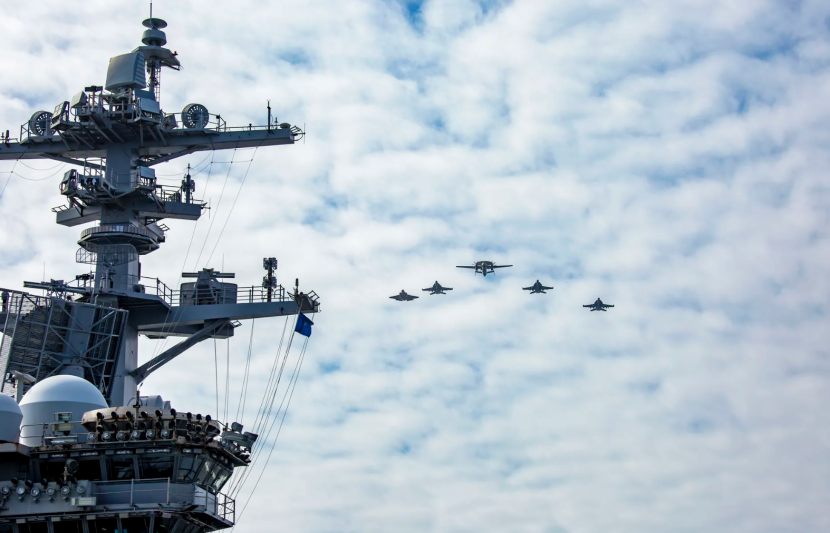
The strike group consists of the USS Abraham Lincoln aircraft carrier accompanied by three guided missile destroyers: the USS Frank E. Petersen Jr., the USS Spruance, and the USS Michael Murphy. The carrier hosts multiple squadrons of advanced aircraft, including F/A-18E/F Super Hornets, EA-18G Growlers, F-35C fighter jets, and MH-60R/S helicopters.
U.S. officials noted that while the strike group has entered the region, it was not yet "on station" as of Monday morning Eastern Time, meaning it hasn't reached its intended final position.
Iran's "Finger on the Trigger" Warning
The deployment comes as Iranian military leaders delivered stark warnings to Washington. Gen. Mohammad Pakpour of Iran's Revolutionary Guard cautioned the U.S. and Israel to "avoid any miscalculation," according to Nournews, an outlet affiliated with Iran's Supreme National Security Council.
"The Islamic Revolutionary Guards and dear Iran stand more ready than ever, finger on the trigger, to execute the orders and directives of the Commander-in-Chief," Pakpour stated over the weekend.
On Monday, Iran's Defense Ministry spokesperson Gen. Reza Talaei-Nik escalated the rhetoric further, warning that any attack by Israel or the U.S. would "be met with a response that is more painful and more decisive than in the past."
Trump's "Massive Fleet" Statement
President Trump announced Thursday that the United States had deployed a "massive fleet" toward Iran "just in case" military action becomes necessary, though he added, "maybe we won't have to use it."
The president has repeatedly issued warnings to Iranian leaders regarding their treatment of protesters and the reported mass executions of demonstrators arrested during recent unrest.
Military Capabilities on Display
The Abraham Lincoln strike group represents one of the most formidable naval assets in the U.S. military arsenal. The carrier can launch and recover dozens of aircraft for various missions, from air superiority to ground strikes. The accompanying guided missile destroyers provide layered defense against air and missile threats while also carrying offensive cruise missile capabilities.
The F-35C fighter jets aboard the Lincoln are among the most advanced stealth aircraft in the world, capable of penetrating sophisticated air defenses. The EA-18G Growlers provide electronic warfare capabilities that can disrupt enemy radar and communications systems.
Rising Tensions Over Domestic Unrest
The military standoff unfolds against the backdrop of significant internal challenges facing Iran's government. Protests that began in late December have emerged as the largest challenge to the country's ruling regime in years, with demonstrators taking to the streets across multiple cities.
Reports indicate that Iranian authorities have responded harshly to the protests, with concerns about mass executions of arrested demonstrators. The death toll from the crackdown has reportedly exceeded 12,000, though exact figures remain difficult to verify due to Iran's tight control over information.
This domestic instability may be influencing Tehran's calculations regarding how to respond to external military pressure. Historically, authoritarian regimes facing internal legitimacy crises sometimes adopt more aggressive foreign policy stances to rally nationalist sentiment and distract from domestic problems.
Trump Administration's Iran Strategy
The current administration's approach to Iran represents a combination of military deterrence and vocal support for Iranian protesters. Trump has made the treatment of demonstrators a central talking point, repeatedly warning Iranian leaders against violence toward peaceful protesters.
This dual approach—military pressure coupled with rhetorical support for regime opponents—signals a strategy that goes beyond traditional military deterrence. The administration appears to be applying pressure on multiple fronts simultaneously, both external through military deployments and internal by amplifying criticism of the regime's handling of dissent.
The "just in case" framing of the carrier deployment leaves ambiguous whether Washington is preparing for potential strikes, seeking to deter Iranian actions, or creating leverage for possible future negotiations. This strategic ambiguity may be intentional, keeping Iran's leadership uncertain about American intentions while maintaining flexibility for U.S. decision-makers.
What Happens Next
The positioning of a carrier strike group in the region significantly expands U.S. military options should tensions escalate further. However, such deployments have historically served primarily as deterrence, with actual military action remaining relatively rare.
The coming days will likely see continued verbal exchanges between Washington and Tehran as both sides seek to signal resolve without necessarily committing to military conflict. Regional allies and adversaries will be watching closely to assess whether this deployment represents a prelude to action or a powerful reminder of American military presence in the Middle East.
With Iranian protests continuing and international attention focused on the regime's response to domestic dissent, the intersection of internal Iranian politics and external military pressure creates an particularly unpredictable dynamic in the region.
© 2026 HNGN, All rights reserved. Do not reproduce without permission.


